One of the keys to developing a balanced workout program which targets all your major muscle groups is understanding how the major joints in your body work and the muscles which act on them.
There are seven main movement patterns of your body they are squat, lunge, push, pull, twist, bend and gait (walk). All these occur in tasks of daily living and in sports. If you want to move better, improve your posture and perform better it is essential to strengthen the muscles that enable these movements.
We are going to explore these movements one by one, we will discuss the muscles working and the best exercises to do to strengthen them. We will then discuss different types of contractions and I will conclude this series by bringing it all together so you can have an idea on how to develop a basic program for yourself.
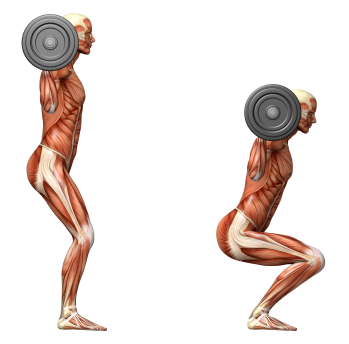
Today we are going to start with the squat movement pattern. The muscles working during any movement will be the ones responsible for the action when the resistance is moving against gravity or the up / concentric phase. When you squat, your hip is extending on the way up, the gluteus maximus is the major muscle responsible for this, your knees are also extending- your quadricep muscles provide this movement and your ankle is plantar flexing working your calf muscles.
With a squat you are working your biggest muscle groups in a functional way. The value of the squat as an exercise is one which cannot be overstated, it is so easy to progress your squat as you get stronger by increasing the depth or the weight, doing a one-legged squat or performing jump squats. When you squat with proper technique you also activate a lot of stabiliser muscles throughout your body, which we will not explore just yet.
The squat is perhaps the best exercise you can do to build strength, improve stability and mobility in your lower limbs.
References
Baechle, T.R. & Earle, R.W. (2008). Essentials of Strength and Conditioning. Human Kinetics.
Chandler, T.J., Wilson, G.D., & Stone, M.H. (1989). The effect of the squat exercise on knee stability. Med Sci Sports Exerc 21: 299–303.
Escamilla, R.F., Flesig, G.S., Lowry, T.M., Barrentine, S.W. & Andrews, J.R. (2001). A three-dimensional biomechanical analysis of the squat during varying stance widths. Med Sci Sports Exerc 33: 984-998, 2001.
Martini, F.H., Nath, J.L. & Bartholomew, E.F. (2012). Fundamentals of Anatomy and Physiology. Pearson.
 Body KnowlEDGE