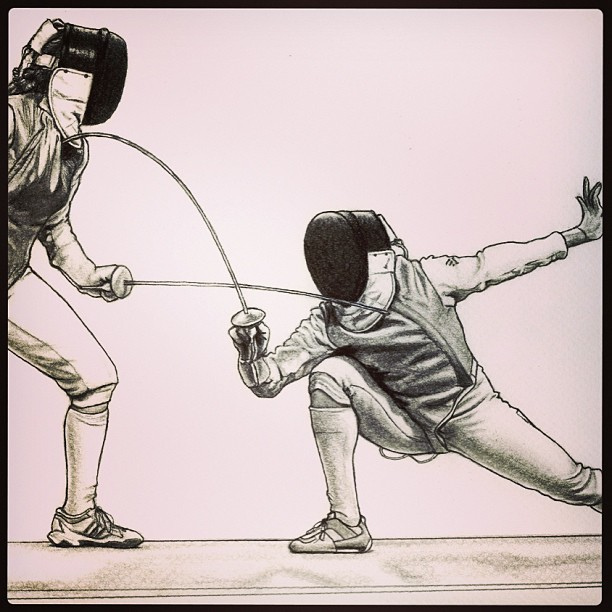
Today we are going to continue exploring fundamental movement patterns by evaluating lunging. When you walk, when you step up stairs, when you stand up after sitting on the floor you are doing a variant of lunge movement pattern. I your sport is fencing, badminton, tennis, or martial arts, variants of the lunge are also a big part of your sport.
Like the squat, the concentric or up phase of the lunge involves hip extension, knee extension and plantar flexion at the ankle so the major muscle groups worked during a lunge are the same as those worked during a squat.
Unlike the squat the lunge is a unilateral exercise, this means it focuses on one side of the body at a time. Another key difference with a lunge you step forward before descending, it is for this reason the lunge is often use to test dynamic stability in athletes, rehabilitation patients and the elderly. There are a lot stabilising muscles throughout the body which need to be activated in order for somebody to perform the movement well.
A common misconception about the lunge is that it is a quad/ knee extensor dominant exercise while the squat focuses more on your hip extensors. This does not reflect studies analysing the movement which indicate the lunge like the squat is a hip extensor dominant movement. A 2012 study published in the Journal of Athletic Training analysing the forward lunge found that the hip extensors contributed 62 per cent, while the knee extensors contributed 17 per cent.
Like the squat, the lunge can be adapted by adding weight, or doing jump lunges, because it is an unilateral exercise you can also vary difficulty by elevating a leg. Variations of the lunge include step ups, and split squats (a static lunge).
So which is better the squat or the lunge? We will talk a little bit more about that later in the week.
References
Jonhagen, S. Halvorsen, K. & Benoit, D.L. (2009). Muscle activation and length changes during two lunge exercises: implications for rehabilitation. Scandinavian Journal of Medicine and Science in Sport 19 561-568.
Riemannn, B.L., Lapinski, S., Smith, L. & Davies, G. (2012). Biomechanical analysis of the anterior lunge during four external load conditions. Journal of Athletic Training 47(4): 372-378.
Stuart, M., Megian, D. A., Lutz, G.E., Growney, E.S. & An, K. (1996) Comparison of intersegmental tibiofemoral joint forces and muscles activity during various closed chain exercises. The American Journal of Sports Medicine Vol24. No 6.
 Body KnowlEDGE