If your sport is rock climbing, rowing, or bar calisthenics, then the pull movement pattern is a huge part of your sport. But it is not only climbers, rowers and the Bar Stars who use some variant of the pull movement pattern throughout their day, pulling is another fundamental movement pattern. Every time you pick up a child, drag something toward you or pick up anything of the ground you are using a pull movement pattern.
The pull movement pattern can be grouped into two categories- vertical and horizontal pull. With horizontal pull, you are bringing a resistance which is in front of your body closer to your midline. Vertical pull can be a little confusing, because you tend to be bringing your arms down while the resistance is going up, just always remember to think about whether the resistance is moving up or down and how the joints move to facilitate that. So while the bar is moving downwards during a lat pull down the weight / resistance is moving against gravity, making it the up-phase.
For both vertical and horizontal pull the movement at the elbows is flexion. Whenever your elbow flexes during the upward phase your bicep is primarily doing the work. The role of the shoulder joints in these movements is not as simple, but before we go into that, let’s talk about two muscle actions we have not yet discussed, adduction and abduction.
Adduction involves moving a bone closer to the midline of your body, while abduction is moving a bone away from the midline. When you do a pull up (an overhand / pronated grip chin up) your shoulders are adducting because your arm is being brought towards the midline of the body as the resistance is moving upwards. The other movement at the shoulder that may be involved in a pull pattern is shoulder extension, when you do a seated row your shoulder is extending. Your lats both adduct and extend the shoulder and thus will be activated in any pull pattern exercise involving the shoulder joint. Teres major (a back muscle) is also capable of producing both these movements.
Other movements at the shoulder relate to how your scapula or shoulders blades move during an exercise. The position of your shoulder blades at rest has a large effect on your everyday posture because your scapula relies on muscles to keep it in place against your back. Think about shoulder blade adduction as your shoulder blades moving closer together, this will occur during both horizontal and vertical pull exercises and is a movement primarily facilitated by your rhomboids, and traps .
One of my favourite exercises which I think is criminally underutilised in exercise prescription is the supine pull also known as the inverted row. This is a body weight horizontal pull exercise which is great for strengthening your back muscles and your biceps and you can pretty much do anywhere indoors. It is a shoulder extension and elbow flexion exercise. You can adapt it to make it harder by slowing down the down phase. Some other great horizontal pull exercise include the barbell row, seated row and one arm dumbbell row.
My favourite and arguably the best vertical pull exercise is probably the pull up, this a bodyweight exercise which can also be progressed by slowing down the down phase of the exercise, if you are not quite ready to do pull ups, practising slow descends on the bar after jumping up or using a chair to go up will help you build the strength for pull ups, the lat pulldown is also another shoulder adduction/ elbow flexion vertical pull exercise. Chin ups or lat pull downs with an underhanded grip are shoulder extension vertical pull exercises. The underhanded grip makes the movement easier because the line of pull is one the bicep favours enabling it contribute more to the movement than it could with an overhand grip.
As I mentioned before strengthening your shoulder muscles is not only important for improving your ability to perform pull pattern movements, but it also important for good posture. You have probably noticed a lot of people these days tend to have rounded shoulders, and a forward head this is a sign that their shoulder blades are abducted and thus not resting in the right position, this implies that the muscles responsible for adducting the scapula might be weak and other muscles are tight. A 2005 study investigating the effects of a 10 week exercise intervention program which included exercises that strengthen the muscles that adduct the shoulder blades helped correct the problem of rounded shoulders and forward head posture. What does this mean for you? If your shoulders a little rounded or your head a little forward then including some horizontal pulling exercises such as the seated row or inverted row could help correct your posture because they strengthen the muscles responsible for keeping your shoulder blades in place when they are at rest.
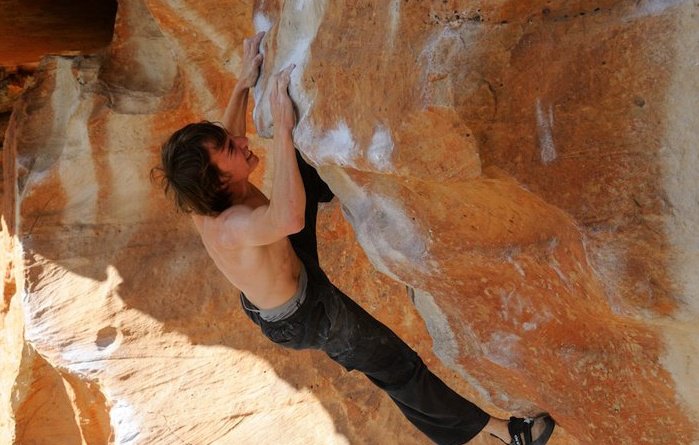
The above photo features the incredible Australian rock climber Byron Glover bouldering in the Grampians. To see more of his Grampian climbing adventures check out his youtube channel ByronGlover.
References
Baechle, T.R. & Earle, R.W. (2008). Essentials of Strength and Conditioning. Human Kinetics.
Hernman, K., Hubley-Kozey, C.L. & Butler, H. (2005) Effectiveness of an exercise program to improve forward head posture in normal adults: a randomised 10-week trial. The Journal of Manual & Manipulative Therapy. Vol.13 No.3; 163-176.
Martini, F.H., Nath, J.L. & Bartholomew, E.F. (2012). Fundamentals of Anatomy and Physiology. Pearson.
 Body KnowlEDGE